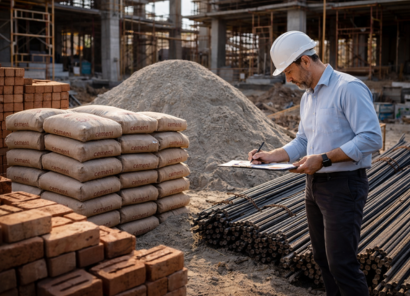
Selecting the right construction materials is one of the most critical decisions you will make when building your home or commercial property. The materials you choose directly affect the structural strength, longevity, energy efficiency, maintenance costs, and aesthetic quality of your building.
With hundreds of options available in the Indian market — from traditional red clay bricks to modern AAC blocks, from M25 to M50 grade concrete, and from conventional clay tiles to insulated metal roofing — the choice can be overwhelming. This comprehensive guide by Manikanta Constructions will walk you through the key material decisions and help you make informed choices for your specific project.
1. Cement – The Backbone of Construction
Cement is the most fundamental building material, and choosing the correct grade and brand can make a significant difference to your structure's durability and cost.
Types of Cement Used in India
- OPC (Ordinary Portland Cement): Ideal for structural work — columns, beams, slabs, and foundations. OPC 53 grade is recommended for RCC structures due to its high early strength.
- PPC (Portland Pozzolana Cement): Best for masonry, plastering, and waterproofing applications. It generates less heat and is more resistant to sulphate attack.
- PSC (Portland Slag Cement): Excellent for marine environments and sulphate-rich soils. Provides superior long-term strength and durability.
Pro Tip: Always verify the cement's date of manufacture. Cement older than 3 months should be tested before use. At Manikanta Constructions, we conduct mandatory cube-strength tests on every cement batch used in our projects.
2. Steel – Structural Strength
Reinforcement steel (TMT bars) is the skeleton of any RCC structure. The quality of steel determines your building's ability to withstand earthquakes, wind loads, and other structural stresses.
Choosing the Right TMT Steel
- Fe 415: Standard grade for conventional residential construction. Good balance of strength and ductility.
- Fe 500 & Fe 500D: Recommended for seismic zones and multi-storey buildings. The 'D' denotes enhanced ductility.
- Fe 550 & Fe 600: High-strength grades used in large-span commercial structures, bridges, and industrial buildings.
Always purchase TMT bars from BIS (Bureau of Indian Standards) certified manufacturers and insist on mill test certificates for every batch. Brands like TATA Tiscon, JSW Neosteel, Vizag Steel, and Rashtriya Ispat Nigam are trusted choices in South India.
3. Bricks & Masonry Units
The choice of masonry material affects your wall's thermal performance, structural load, construction speed, and cost.
Red Clay Bricks vs AAC Blocks vs CLC Blocks
- Red Clay Bricks: Traditional, strong, and proven over centuries. Provide good thermal mass. However, they are heavier, require more mortar, and can be inconsistent in quality depending on the kiln.
- AAC (Autoclaved Aerated Concrete) Blocks: Lightweight, thermally efficient, dimensionally accurate, and faster to lay. Reduce dead load on the structure, lower cement consumption, and improve acoustic insulation. Highly recommended for multi-storey buildings.
- Fly Ash Bricks: Manufactured using coal fly ash, these are denser than clay bricks, have consistent dimensions, and are more eco-friendly. Excellent compressive strength and lower water absorption.
4. Sand – Quality Often Overlooked
River sand (M-sand) is essential for concrete mixing and plastering. The quality of sand directly impacts the strength of your concrete and the smoothness of your plaster finish.
In recent years, manufactured sand (M-sand) has become the preferred alternative to river sand due to dwindling natural sand availability and government regulations. M-sand produced from crushed granite has controlled particle size, is free from organic impurities, and provides consistent concrete strength.
5. Roofing Materials
Roofing is your home's primary line of defence against the elements. In Hyderabad's climate — characterised by intense summer heat, heavy monsoon rain, and occasionally strong winds — choosing the right roof type and material is crucial.
Popular Roofing Options for Indian Homes
- RCC Flat Roof with Waterproofing: The most common choice for urban homes. When done correctly with proper slopes and quality waterproofing membranes, it provides excellent durability and usable terrace space.
- Mangalore Clay Tiles (Sloped Roof): Excellent for areas with heavy rainfall. Provides natural ventilation, is thermally comfortable, and requires minimal maintenance.
- Metal Roofing (PPGI / PPGL Sheets): Ideal for industrial buildings, warehouses, and commercial sheds. Lightweight, fast to erect, and available with thermal coating.
- Insulated Roofing Panels: Premium option for luxury homes. Provides superior thermal and acoustic insulation, significantly reducing cooling costs.
6. Flooring Materials
The choice of flooring material defines the character of every room. Common options include vitrified tiles, natural stone (marble, granite, kota), hardwood and engineered wood, and epoxy coatings for industrial spaces.
Recommendation: For living areas, 800×800mm or 1200×600mm large-format vitrified tiles with a rectified edge are a cost-effective premium choice. For bathrooms, use anti-skid ceramic tiles or natural stone with slip-resistant finishes. For outdoor areas, use 20mm-thick outdoor granite or rough-finished kota stone.
7. Waterproofing Systems
Waterproofing failures are among the most common and costly construction defects in Indian homes. Every terrace, bathroom, kitchen slab, and external wall needs a properly designed and installed waterproofing system.
Modern waterproofing systems include: crystalline admixtures added directly to concrete, torch-applied bituminous membranes for terraces, polyurethane (PU) liquid-applied membranes for bathrooms, and acrylic polymer coatings for external walls. At Manikanta Constructions, we provide a 5-year waterproofing guarantee on all our projects.
8. Paints & Finishes
The paint system you choose protects your structure from weathering, UV radiation, moisture, and biological growth, while also defining your home's visual identity. Always insist on at least two coats of primer followed by two finish coats for exterior walls. Use elastomeric paints or texture coatings for maximum weather protection in areas with high rainfall like Hyderabad's monsoon season.
Final Material Selection Checklist
- Always buy from BIS-certified manufacturers and request test certificates.
- Never compromise on structural materials (cement, steel, concrete) — savings here lead to costly repairs later.
- Consider lifecycle cost, not just upfront cost, when evaluating materials.
- Choose regionally available materials to reduce transportation costs and carbon footprint.
- Consult your structural engineer before substituting any specified material.
Making the right material choices requires a combination of technical knowledge, market awareness, and project-specific thinking. At Manikanta Constructions, our team provides detailed material specifications and procurement support to ensure every component of your project meets the highest quality standards. Reach out to us today for a free materials consultation.